Thursday, 24 November 2016

Oral communication is the process of expressing information or ideas by word of mouth. Learn more about the types and benefits of oral communication, and find out how you can improve your own oral communication abilities”

This year I began tutoring a Grade 3 student for both math and language. Through this process I have realized the importance of communication, not just communication from the student, but also communication as a teacher. Part of communication requires us to have both listening and speaking skills, and these are important foundations to develop as students and people.  In the final chunk of our time in classes before our teaching block, we have been looking at oral communication. I have really enjoyed this strand because there are many different interactive activities that fulfill the expectations.

Below are the expectations for the Oral Communication strand in the Ontario Curriculum
Overall Expectations:
  1. Listen in order to understand and respond appropriately in a variety of situations for a variety of purposes;
  2. Use speaking skills and strategies appropriately to communicate with different audiences for a variety of purposes;
  3. Reflect on and identify their strengths as listeners and speakers, areas for improvement, and the strategies they found most helpful in oral communication situations.
Let’s Talk about Listening Article
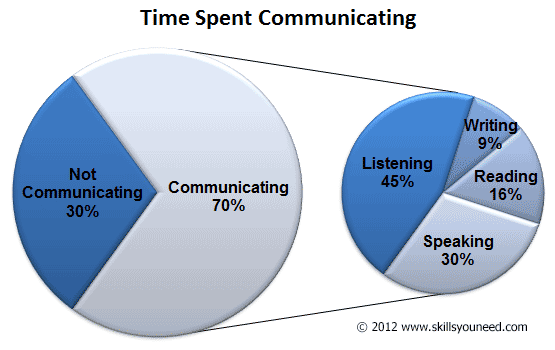
One resource that I looked at for Oral Communication was found on Edugains and is called “Let’s talk about listening”. It argues that listening is the most important skill for “obtaining comprehensible input in one’s first and any subsequent languages. It is a pervasive communicative event: we listen considerably more than we read, write, or speak”. Listening is an active process and something that must be practiced. This is why it is an important part of the Ontario Curriculum under oral communication. Since talking and discussing play a central role in the classroom it is important to teach students to be effective listeners, which will help develop critical thinkers. I have found this to be particularly true in all subjects in school. When I have worked with students I tutor and in my placement I have tried to generate discussion and ask thought provoking questions to encourage deeper thinking and understanding of the material we are studying.

 The article explains how important it is for teachers to model good listening for their students to encourage the same behaviour from their students. This message of teachers modelling the behaviour they expect of students is one that I have found to be very important and applicable in the past three weeks in my own experience. The article highlights the relationship between listening, speaking, reading, and writing. This makes incorporating the different strands into activities very easy for teachers. The article includes activities that can encourage listening comprehension (ex. Quick Writes, Graffiti, ReQuest, Inside-Outside).


Debates: Where Speaking and Listening Come First Article
Another great activity to foster student’s oral communication skills is debates. We looked at an article that discusses the benefits of conducting debates in the class to help engage students and develop speaking, reading, and writing skills. It explains how debates can support student’s critical thinking through their research and reasoning of evidence when they have to be able to argue both points of view. When students debate with each other, it encourages positive collaboration between peers. Debates can aid in developing students listening and speaking abilities because peers need to listen to students on their debate team in order to form ideas to counter. When students are engaged in a debate their speaking skills are critical so they can communicate their thoughts effectively, they need to be clear and specific with their points, as well as helps develop their vocabulary.

I really like the idea of using debates in the classroom, I think it can help students not only develop their reading, writing, listening, and speaking skills, but also how they work with their peers. Students ability to learn to develop substantial arguments from evidence can help them when it comes to persuasive writing, as well as reading closely and thinking critically about what they have read.


Resources
Here is a list of some resources I found that offer some great activities to promote oral communication in the classroom. Many of these activities can be modified to suit your own class as well as grade level.

·      This is a list of easy activities that can spark conversations in the classroom, and can be modified for different subjects.
·      These can be done is small groups or in pairs


·      This is typically done for primary grade
·      This is another activity that has students talk in small groups, where a table is set up with various prompts
·      As an extension to this, students can pair up and do a written aspect where they write about what they heard their group mates say.


Video Resources

            In this past week, we looked at some resources that had a wide range of educational videos to show in class. I found a video from the National Film Board that I will use in my teaching block for my unit on Residential Schools. The video I chose is called “Sisters and Brothers”, and is a short trailer of indigenous children going to residential schools, as well as the hunting of the buffalo. The focus on the trailer is Indigenous culture that had been lost due to the residential schools. Indigenous people created the film, and shows black and white clips with background music. There is no oral conversation or narrative in the trailer, which is a great opportunity for students to use inferring skills. I plan on using this as part of my introduction to the unit, and will accompany the video with a discussion and written part.

Wednesday, 9 November 2016

Enabling the Best Writer's

Writing ... provides students with powerful opportunities to learn about themselves and their connections to the world. Through writing, students organize their thoughts, remember important information, solve problems, reflect on a widening range of perspectives, and learn how to communicate effectively for specific purposes and audiences. They find their voice and have opportunities to explore other voices. By putting their thoughts into words and supporting the words with visual images in a range of media, students acquire knowledge and deepen their understanding of the content in all school subjects. Writing also helps students to better understand their own thoughts and feelings and the events in their lives.
                                                                                             
                                                                                             - Ontario Curriculum 1-8 Language (p.12)
            
When I was a student I remember always enjoying the writing aspect of school, and in terms of assessment I excelled when I had the opportunity to write down and explain my thoughts. As a teacher, I have seen some students have an aversion to writing for school purposes and I asked myself why is this? Is it because they are not engaged in the material that they have to write about? Is it because they are not confident in their writing ability? Or do they not feel confident in being able to communicate that way?

            I have a grade 3 student that I work with who has a tendency to rush through his work, and when it comes to writing he creates very short sentences. Although when he verbally explains his thoughts, he goes into rich detail and talks forever! Instead of doing traditional comprehension questions after reading a story I tried to do a “Genius hour” project with him. This was a new activity that I had never executed before, but had recently done one myself through tech class. I let him chose the topic, we did the research together (using various sources, text and media). After completing the research and compiling thoughts on a mind web, I had him create his own picture book with “Storybird” where he wrote the paragraphs and chose the images. Once he was finished, I had him go through and edit any mistakes, or fix sentence structure. This was a great way to keep him engaged and practicing his thinking skills, reading and comprehension, and finally his writing skills.

Curriculum Expectations
  1. Generate, gather, and organize ideas and information to write for an intended purpose and audience;
  2. Draft and revise their writing, using a variety of informational, literary, and graphic forms and stylistic elements appropriate for the purpose and audience;
  3. Use editing, proofreading, and publishing skills and strategies, and knowledge of language conventions, to correct errors, refine expression, and present their work effectively;
  4. Reflect on and identify their strengths as writers, areas for improvement, and the strategies they found most helpful at different stages in the writing process.
Writing Resources
The resource I looked at for writing is called “The Best Part of Me” project and can be found at http://lessonswithlaughter.com/the-best-part-of-me/ .  Although the full lesson plan is located at this website, http://www.scholastic.com/teachers/lesson-plan/best-part-me . This project encourages students to look at all the positive aspects about themselves, and write about it to be shared around the classroom. This project can incorporate the media strand, or art by incorporating an image/visual aspect to the assignment. This assignment can be altered or modified to fit the class level, and can be as long or as short as you want it. If you wanted to do it over a span of time you could have students come up with one “best of me” a week, and by then end they create a book of all the best things about themselves. The assignment can have a peer and self-editing component that helps with writing skills, as well as practice for giving constructive feedback to peers. What I love about this assignment is that there are different ways you can go about teaching this lesson, and it can be used in most J/I grades. It is also a great way to start the school year, and have students get to know each other.

Writing In the Classroom
While in my placement class I’ve noticed that a lot of students are struggling with the basics of writing in terms of sentence structure, types of sentences, different narratives, the use of adjectives and nouns, as well as verb tenses. I found a resource called the “interactive notebook” and it is essentially a guide/tip book based on these common writing problems. The great thing about this idea is that it can be done electronically or hardcopy. The resource can be found here.


Another common problem is students need a remind of how to format essays and paragraphs. This is where anchor charts around the classroom or in their writing books can be a great resource to have students refer to. While searching for resources I found a great essay outline template that teachers can have students fill out while they are formulating ideas, arguments, and proof points. The outlines can be found here.


Sunday, 30 October 2016

Multilevel Texts for Reading

Palomar College 
"An effective reader is one who not only grasps the ideas communicated in a text but is able to apply them in new contexts. To do this, the reader must be able to think clearly, creatively, and critically about the ideas and information encountered in texts in order to understand, analyse, and absorb them and to recognize their relevance in other contexts." 
-The Ontario Curriculum, Reading (p.10) 

My Own Experience
From my own experience I have seen how it can be a struggle to encourage and engage students to read. As a kid, I lacked motivation for reading and I remember struggling with it in the first couple of grades. However, as I got older I started finding out what types of books or texts I was interested in and that lead me to getting an English degree at Mcmaster University. 

For students that struggle with reading on their own it affects their perception of themselves, and completely disengages them from wanting to read. For intermediate students, some of them still struggle with reading at the appropriate level and that plays a larger social role in the classroom, which affects their desire to read. There is also the struggle is finding texts that they are interested in, and that are appropriate for school.


Overall Expectations for Reading From Ontario Curriculum

  1. read and demonstrate an understanding of a variety of literary, graphic, and informational texts, using a range of strategies to construct meaning;
  2. recognize a variety of text forms, text features, and stylistic elements and demonstrate understanding of how they help communicate meaning;
  3. use knowledge of words and cueing systems to read fluently; reflect on and identify their strengths as readers, areas for improvement, and the strategies they found most helpful before, during, and after reading. 
Reading Resources 

https://www.flickr.com/photos/mboezi/galleries/72157650765353571/ 
One resource that I found for the reading strand is an article about multilevel texts, and can be found on "Edugains". The article explains that multilevel texts are distinct from levelled texts in that they are written at higher levels of complexity and are suitable for two or more levels of reading, whereas levelled texts control the vocabulary based on reading level. 

Multilevel texts are different from levelled texts because of their various points of view, and use a variety of formatting to emphasize a voice. A couple examples of multilevel texts are texts that use multiple genres of texts and formats to communicate information, such as text boxes and cartoons. Another example is a novel that incorporates both fiction and non-fiction, or poetry and informational texts. 

These multilevel texts act as hybrids that combine various forms of literature, and can communicate information in a variety of forms. One of the most important benefits of multilevel texts is the evidence that the these texts encourage an inclusive classroom, because students of different abilities are able to engage in the same text. Multilevel texts can be a great resource for the classroom because it engages students who are at different reading levels, and depending on the form of the text, it can expand reading skills in a variety of media types. 

Multilevel texts can incorporate multiple genres of literacy, which could appeal to more students, and enhance student engagement.  In the Ontario curriculum, multilevel texts incorporate these expectations:  “Recognize a variety of text forms, text features, and stylistic elements and demonstrate understanding of how they help communicate meaning” and “Read and demonstrate an understanding of a variety of literary, graphic, and informational texts, using a range of strategies to construct meaning”. By reading multilevel texts students have a chance to analyze the text and communicate their knowledge in their writing. 

Here is a link to some multilevel texts 

Reading in Placement 

In my grade 6 class, there are a range of reading levels between 28 students, which can make it difficult to choose one book for the whole class to read. I think this is where multilevel texts would be a great idea to incorporate in the class.  Another idea to use in the classroom would be a "Daily 5", which is a rotation of reading and writing stations of students. 

Students could be group in their reading levels, and could be done every day for 30-40 minutes. This would let students read their choice of text for a station, and another station could be with the teacher where students discuss a previously read article. The last idea that I saw was an "Article board wall", which had daily articles for students to work on during class time or take home for homework. It encourages reading for a short period of time, and critical thinking through answering some questions or writing a paragraph about the article. 

From my previous post about media, it may also be beneficial to use technology to incorporate reading in the classroom. Whether it's having students read various blogs or ebooks. One website I found really interesting was 2titles, it's a website that has you do a brief personality quiz and then it produces a wide range of books you may be interested in. Students could do this at the beginning of the year and this could help teachers get a better idea of what their students are interested in reading.